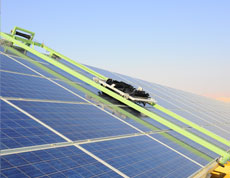
Robots Clean Solar Panels Without Water

Israeli innovator Ecoppia has developed a solar powered robot that cleans PV panels without water. The microfiber technology has been in use for a year now at Ketura Sun in the Arava desert and has increased the energy efficiency by around 5% every month. Conventional cleaning methods involve the use of water and man power, while the robots use no additional energy, no water and clean the panels every evening at dusk.

ecoppiapic1


For more information about Ecoppia and the E4 robot, please visit their website http://www.ecoppia.com

Posted in Blog Post | Leave a comment

Fossil Fuels as Clear and Present Danger

Courtesy of the Huffington Post

Last weekend I had the opportunity to participate in the 2014 Truman National Security Project Conference where several impressive speakers offered a reminder that many of our country's groundbreaking advances have come out of The Pentagon. The "mysterious" DARPA Program has developed thing that initially only had military aims - such as, the Internet, GPS, and even duct tape, that have since become ubiquitous all over the world. Many invaluable medical, aerospace and engineering advances can all be traced back to the military.

As a member of the Truman Project, I've had the opportunity to meet remarkable people from all over the country. However, among the most impressive men and women in the organization are the military veterans. With a distinguished history of forward-thinking innovations, it was no surprise to hear that many of the veterans at the conference are honing in on our dependency on foreign and fossil fuels as one of the biggest challenges of our generation.

Many of them are involved with Operation Free, which advocates for securing America with Clean Energy. Our military veterans, who have literally been at the front lines of battle, are now at the front lines of moving the American military and country off of fossil fuels. These brave men and women who witnessed their comrades in arms losing their lives as caravans of oil and gas had to drive through deadly warzones are now pushing for things like using wind power and solar power in those remote forward bases.

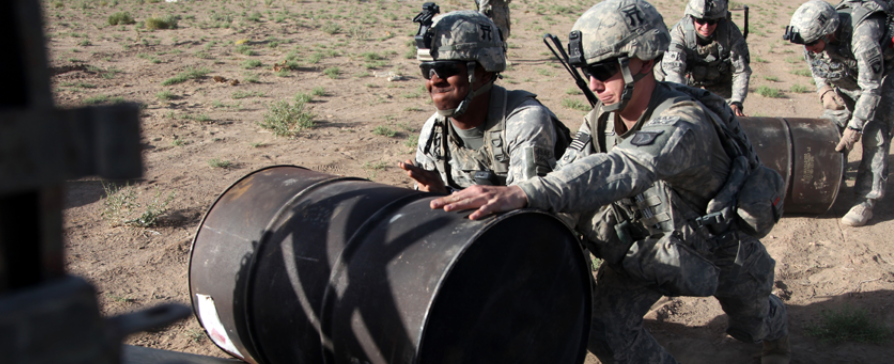
The numbers speak for themselves. We spend roughly $85 billion annually - about 17 percent of the Defense Department's total budget -protecting the oil choke points throughout the world. At the height of the Afghan war, out of every 24 convoys there was at least one casualty. This statistic hits even closer to home when noting that fuel is half of all convoys loads.

That's not even the really bad news. Ready? According to the Quadrennial Defense Review, fossil fuels use exacerbates environmental problems that can lead to regional, national and global instability, making it (yes, this is a scary term) a "threat multiplier".

2014-05-09-ScreenShot20140509at12.10.22PM.png

Fossil fuel use is correlated with increasing our greenhouse gas emissions, and as reported in the recently released National Climate's Assessment, "Climate change, once considered an issue for a distant future, has moved firmly into the present." The projected increase of extreme weather and sea-level rise will place an added burden on the military because we're the best first responders in the world. Right now, our military receives a foreign disaster request once every two weeks, a number that has been on the rise in recent years. As the world's largest and most powerful military, we will play a large role in stabilizing areas of the world where our security interests lie (see: Pakistan, flooding in).

It's that simple, the use of fossil fuel is a threat to our national security.

Operation Free has already seen tangible results. In just the last week, Senator Mark Udall (D-CO) and Congressman Scott Peters (D-CA, 52nd), were joined by formerCongresswoman Gabrielle Giffords to introduce a landmark piece of legislation: The Department of Defense Energy Security Act (DODESA) - which will enable our military to use energy more effectively.

This is one of those issues that tends to sit badly with economic conservatives. While they are wary of renewable energy initiatives as being economically non-viable, in this case one of corporate America's favorite piggy banks, The Pentagon, is ready to dole out the mega-bucks. Navy Secretary Ray Mabus has said these investments are imperative "So we can become better warfighters". This isn't only Birkenstock wearing hippies pushing for this change; it's the military leaders and service members.

And now, Hollywood is hearing the military clamor for change and new movies are being produced. This is a story about our national security that needs to be told and Roger Sorkin is doing just that's Sorkin Productions is creating a documentary that will likely get everyone's attention - the same way "An Inconvenient Truth" did eight years ago. "The Burden" is the kind of film that people inside and outside of the beltway will be drawn to, argue about and change their thinking around. It is also the kind of project anyone concerned about the future should get involved in.

The reality is that for far too long the narrative about renewables and clean energy has tilted towards the doom and gloom of climate change and that's the wrong way to do it. America has always been optimistic and inspirational and innovative it's time to tell the tale of how the entire country will move forward if we support the military in its quest to innovate.

Follow Elie Jacobs on Twitter: www.twitter.com/eliejacobs

Posted in Blog Post | Leave a comment

Climate Change is Here!

U.S. Climate Has Already Changed, Study Finds, Citing Heat and Floods

By 

New-York-Times-Logo

The effects of human-induced climate change are being felt in every corner of the United States, scientists reported Tuesday, with water growing scarcer in dry regions, torrential rains increasing in wet regions, heat waves becoming more common and more severe, wildfires growing worse, and forests dying under assault from heat-loving insects.

Such sweeping changes have been caused by an average warming of less than 2 degrees Fahrenheit over most land areas of the country in the past century, the scientists found. If greenhouse gases like carbon dioxide and methane continue to escalate at a rapid pace, they said, the warming could conceivably exceed 10 degrees by the end of this century.

“Climate change, once considered an issue for a distant future, has moved firmly into the present,” the scientists declared in a major new report assessing the situation in the United States.

Posted in Blog Post | Leave a comment

$100m renewables fund for sub-Saharan Africa

The African Renewable Energy Fund closed its first round of capital raising with $100 million in the bank. The fund hopes to double the amount available for 5-50 MW schemes within 12 months.

Read more: http://www.pv-magazine.com/news/details/beitrag/100m-renewables-fund-for-sub-saharan-africa_100014514/#ixzz2xiIFBuDr

Posted in Blog Post | Leave a comment

Israeli For-Profit Solar Developer with a Non-Profit Soul Increases the Light During Hanukah and Year-Round

by Kit Kennedy

Courtesy of NRDC

http://switchboard.nrdc.org/blogs/kkennedy/for-profit_solar_developer_wit.html#.UynWz18N4qM.email

With Hanukah candles being lit in homes around the world—mine included—starting tonight, you might be interested to know about an early rabbinic debate that has great relevance for our world today.

In celebrating Hanukah, these early scholars wanted to know, should one start with eight lights and work down to one? Or, start with one and work your way up?

If you’ve ever lit Hanukah candles, you know the answer: Start with one and work up. The reason is meant not just literally but metaphorically: During a dark time, such as the one we face now with climate change, it’s best to increase the amount of light in the world.

candles

In Israel and around the globe, a Jerusalem-based solar developer, Energiya Global, is doing just that.   My husband, Matthew Diller, and I had the opportunity to visit Energiya Global's Jerusalem office this summer.  Matthew is dean of  Benjamin N. Cardozo School of Law in New York City (part of Yeshiva University), where Weldon Turner, Energiya Global’s COO, got his law degree. Energiya Global calls itself “a for-profit company with a non-profit soul.”

EG’s think-big idea is this: By 2020, to bring as much as 10,000 megawatts of pollution-free solar power to developing countries. EG is planning clean electricity for up to 50 million people who currently go without, or, instead, depend on high-polluting fossil fuel systems such as dirty diesel generators or kerosene cook stoves and lamps. In the process, Energiya Global hopes to help lift many of these people out of poverty and address the darkness that global warming increasingly presents.

Energiya Global was co-founded by American immigrant Yosef Abramowitz (whosesister-in-law is comedian Sarah Silverman), and got its start after Abramowitz and colleagues built the first utility-scale solar array in Israel in 2011. That event sparked lots of international press, and Abramowitz’s original company, Arava Power, was inundated with inquiries and requests from around the world.

Already, EG has raised more than $800 million in conditional financing, and is at work on projects in Turkey, Romania and Ecuador. More are planned soon, in locations as far flung as South Africa and North Carolina.

In many of the places where Energiya Global has begun to work, solar power is often  cheaper than highly polluting diesel power (often the only other energy option), and bringing solar will not only improve local residents’ health but will also free them from the economic burdens of importing fossil fuels.

One of EG’s most inspiring projects is underway in the African nation of Rwanda. That country of 10.5 million people, riven by genocide in 1994, currently has only about 100 megawatts on the electric grid; about half of that comes from diesel generators. A new Energiya Global solar array will add another 8.5 megawatts. The solar field is being constructed on land leased from the Agahozo-Shalom Youth Village. ASYV raises orphans of the genocide and other vulnerable young people and is modeled after the Israeli children’s villages that raised hundreds of thousands of orphans after the Holocaust. The lease provides ASYV a long-term revenue stream and clean electricity. Energiya Global calls the project a “win-win situation and a natural partnership.”

Hanukah comes at a dark time of year to remind us, perhaps, that miracles are possible. They require some dedication—in fact, the word Hanukah is derived from a Hebrew verb meaning “to dedicate”—and perhaps a bit of Divine spark, too. No doubt, Energiya Global is carrying both of those with them, as they increase and harvest the light that developing countries and the rest of us so desperately need.

Posted in Blog Post | Leave a comment

Scientists Sound Alarm on Climate

By Justin Gillis

New York Times

http://www.nytimes.com/2014/03/18/science/scientists-sound-alarm-on-climate.html?_r=0

Early in his career, a scientist named Mario J. Molina was pulled into seemingly obscure research about strange chemicals being spewed into the atmosphere. Within a year, he had helped discover a global environmental emergency, work that would ultimately win a Nobel Prize.

Now, at 70, Dr. Molina is trying to awaken the public to an even bigger risk. He spearheaded a committee of the American Association for the Advancement of Science, the world’s largest general scientific society, which released a stark report Tuesday on global warming.

The report warns that the effects of human emissions of heat-trapping gases are already being felt, that the ultimate consequences could be dire, and that the window to do something about it is closing.

“The evidence is overwhelming: Levels of greenhouse gases in the atmosphere are rising,” says the report. “Temperatures are going up. Springs are arriving earlier. Ice sheets are melting. Sea level is rising. The patterns of rainfall and drought are changing. Heat waves are getting worse, as is extreme precipitation. The oceans are acidifying.”

In a sense, this is just one more report about global warming in a string going back decades. For anybody who was already paying attention, the report contains no new science. But the language in the 18-page report, called “What We Know,” is sharper, clearer and more accessible than perhaps anything the scientific community has put out to date.

And the association does not plan to stop with the report. The group, with a membership of 121,200 scientists and science supporters around the world, plans a broad outreach campaign to put forward accurate information in simple language.

The scientists are essentially trying to use their powers of persuasion to cut through public confusion over this issue.

Polls show that most Americans are at least somewhat worried about global warming. But people generally do not understand that the problem is urgent — that the fate of future generations (not necessarily that far in the future) is being determined by emission levels now. Moreover, the average citizen tends to think there is more scientific debate about the basics than there really is.

The report emphasizes that the experts have come to a consensus, with only a few dissenters. “Based on well-established evidence, about 97 percent of climate scientists have concluded that human-caused climate change is happening,” it says.

That is not the same as claiming that all questions about climate change have been answered. In fact, enormous questions remain, and the science of global warming entails a robust, evolving discussion.

The new report walks through a series of potential consequences of planetary warming, without asserting that any is sure to happen. They are possibilities, not certainties, and the distinction is crucial for an intelligent public debate about what to do. The worst-case forecasts include severe food shortages as warming makes it harder to grow crops; an acceleratingrise of the sea that would inundate coastlines too rapidly for humanity to adjust; extreme heat waves, droughts and floods; and a large-scale extinction of plants and animals.

“What’s extremely clear is that there’s a risk, a very significant risk,” Dr. Molina said by telephone from Mexico, where he spends part of his time. “You don’t need 100 percent certainty for society to act.”

Some of the scientists on Dr. Molina’s committee like to point out that people can be pretty intelligent about managing risk in their personal lives. It is unlikely that your house will burn down, yet you spend hundreds of dollars a year on insurance. When you drive to work in the morning, the odds are low that some careless driver will slam into you, but it is possible, so we have spent tens of billions of dollars putting seatbelts and air bags in our cars.

The issue of how much to spend on lowering greenhouse gases is, in essence, a question about how much insurance we want to buy against worst-case outcomes. Scientists cannot decide that for us — and the report recognizes that by avoiding any specific recommendations about what to do. But it makes clear that lowering emissions, by some means, is the only way to lower the risks. Because so many people are confused about the science, the nation has never really had a frank political discussion about the options.

Only a few decades ago, the world confronted a similar question regarding chemicals called chlorofluorocarbons, then common in refrigerators, air-conditioners, cans of hair spray and deodorant.

At a Fort Lauderdale, Fla., conference in 1972, a California scientist namedF. Sherwood Rowland learned that they were accumulating in the air. What, he wondered, would happen to them? He eventually put a young researcher in his laboratory, Dr. Molina, onto the question.

To their own shock, the team figured out that the chemicals would break down the ozone layer, a blanket of gas high above the ground that protects the world from devastating levels of ultraviolet radiation. As the scientific evidence of a risk accumulated, the public demanded action — and eventually got it, in the form of a treaty phasing out the compounds.

Global warming has been much harder to understand, not least because of a disinformation campaign financed by elements of the fossil-fuel industry.

But the new report is a recognition among scientists that they bear some responsibility for the confusion — that their well-meaning attempts to convey all the nuances and uncertainties of a complex field have obscured the core message about risks. The report reflects their resolve to try again, by clearing the clutter.

Will the American people hear the message this time?

Posted in Blog Post | Leave a comment

Chaim Motzen IsraelDev Member of the Month

IsraelDev Member of the Month

chaim motsen

Chaim Motzen, Managing Director of Energiya Global, recently secured $23.7M in financing to build an 8.5 MW solar photovoltaic power plant in Rwanda. The project, developed from concept stage to financial close by Chaim, is East Africa’s first utility-scale solar field and will increase Rwanda’s power generation capacity by approximately 8%. Construction of the field, located at Agahozo-Shalom Youth Village, has already begun. Commercial operation is expected summer of 2014.

Posted in Blog Post | Leave a comment

At AIPAC, Two Energy Entrepreneurs Debate Israel’s Future

ForwardLogo


By Hody Nemes

Published March 03, 2014

Israel faces the prospect of freeing itself from dependence on foreign oil in the near future, with potentially transformative impact on the country’s economic and political future, two experts agreed Sunday during the American Israel Public Affairs Committee conference in Washington.

But Yosef Abramowitz and Harold Vinegar, two entrepreneurs seeking to upend Israel’s energy future, differed radically in their respective visions of Israel’s path toward this goal at a Sunday breakout session at the annual gathering.

Hailed as “Captain Sunshine,” Abramowitz wants Israel to become a leader in solar energy production. As the co-founder of the Israeli solar energy firms Arava Power Company and Energiya Global, he has helped build several solar fields in Israel and is working to build solar projects in developing countries as well. He is also considering a run for Israel’s presidency as the incumbent,Shimon Peres, prepares to retire; he told the Forward he will decide next week.

Abramowitz said climate change has added urgency to his quest to build a clean energy economy.

“As a species we’re running out of time,” Abramowitz said. “As partners of God and custodians of the environment, we’re failing.”

Vinegar, the chief scientist of Israel Energy Initiatives, an Israeli energy startup, wants Israel to develop its massive reserves of shale oil, a precursor to useable fuel, which is locked tightly into underground rock formations and must be heated to nearly 600 degrees Fahrenheit before it can be used. Shale oil is difficult to extract and process, and produces more climate-damaging greenhouse gases than conventional oil. Vinegar estimates Israel’s shale oil reserves at around 250 billion barrels of oil, roughly the same as Saudi Arabia’s oil reserves.

Israel recently made some strides in its quest for energy independence, thanks to the discovery of massive Tamar and Leviathan natural gas fields in the Mediterranean. The two fields hold enough gas to supply Israel’s needs for decades and have raised expectations that Israel will become a major energy player in the Middle East. But Vinegar wants Israel to produce its own oil, not just natural gas.

“If you think the natural gas has had a big effect, just wait till you see the effects of hundreds of billions of barrels of oil,” he said. “It’s going to revolutionize the country.”

Abramowitz countered with his view that fossil fuels – like coal, oil, and natural gas – should serve only as transition fuels on the road to a renewable energy economy. Fossil fuels are the primary drivers behind climate change, which is causing increasingly severe weather around the globe, disrupting agriculture, and raising sea level. “We in the pro-Israel community need to make some difficult choices,” he said. “Do we want to perpetuate a world that does use oil, or do we have a different vision?”

Abramowitz expressed astonishment that Israel, with its reliable year-around access to sunlight in the Negev and elsewhere, had only committed itself to obtaining 10% of its energy from renewable sources, like solar and wind power, by 2020. He called that target “really, incredibly, embarrassingly modest” and voiced dismay that the government has not been eager to allow more solar projects in the country.

Vinegar said he was not opposed to developing Israel’s solar potential – and would welcome a tax on fossil fuels to fund research and development of renewable energy sources. “We believe renewables and fossil fuels can coexist and help each other,” he said.

Abramowtiz wants Israel to show the way for other nations to reduce their dependence on fossil fuels. He specifically called on the Jewish state to use natural gas to produce electricity instead of the much more polluting coal and diesel on which it now significantly relies. He also wants Israel to start using electric cars and to invest in better electric storage capability to allow solar plants to store electricity for use overnight.

The timeliness of the two advocates’ debate was underlined by an event taking place outside the conference at Walter E. Washington Convention Center, even as they spoke. At a protest outside the White House, just a few blocks away, hundreds of college students from around the country called on President Obama to reject the proposed Keystone XL pipeline, which would transport tar sands oil from Alberta to refineries in the Gulf Coast. Like Vinegar’s shale oil, tar sands oil is difficult to extract and produces more greenhouse gases than regular oil.

The protest ended with 398 students arrested in an act of civil disobedience.

The event was the brainchild of Michael Greenberg, a Jewish sophomore at Columbia University, who is heavily involved in the Columbia Hillel and the Columbia chapter of J Street, a progressive Israel advocacy group.

“The Keystone decision symbolizes the choice between finding progressively worse forms of energy, or making the transition to safer and more just ways of powering our society,” Greenberg said. “President Obama has been waffling on his commitment to future generations and putting our bodies on the line could be our most powerful tool for holding him accountable.”

w-AIPAC-energy

Posted in Blog Post | Leave a comment

Rwanda field reaches financial close, begins construction


download PDF: 20140217_Gigawatt Global Rwanda release - Feb-17-2014 FINAL-3


FOR IMMEDIATE RELEASE

17 February 2014


Construction Begins on

East Africa’s First Utility-Scale Solar Field

Breakthrough project “a game-changer

for humanity and the environment”


Dutch solar developer Gigawatt Global Coöperatief successfully closed on $23.7 million in financing on an 8.5 megawatt solar photovoltaic (PV) power plant from an international consortium of equity investors and debt providers including Norwegian development finance institution Norfund, Norwegian-headquartered Scatec Solar, Dutch development bank FMO and the Emerging Africa Infrastructure Fund (EAIF).  The project, East Africa’s first utility-scale solar field, will increase the country’s power generation capacity by approximately 8%.


FMO arranged the senior debt package for the Rwanda project. The other senior lender is EAIF. Norfund provided a mezzanine loan and equity.  Scatec is the lead equity investor and is serving both as the engineering, procurement and construction (EPC) and Operations and Maintenance (O&M) provider.


The PV plant will be located 60 km from the capital of Kigali on land belonging to the Agahozo-Shalom Youth Village (ASYV) for youth orphaned during and after the 1994 Rwandan genocide. The electricity will be fed into the national grid under a 25 year power purchase agreement with the Rwanda Energy, Water and Sanitation Authority (EWSA). Construction has already started and commercial operation of the solar field is expected by summer of 2014.


“It takes a global village to raise a solar revolution,” said American-Israeli entrepreneur and human rights activist Yosef Abramowitz, President of Gigawatt Global and CEO of Energiya Global Capital, Gigawatt’s Israeli affiliate that provided seed money and strategic guidance for the project. “There are 550 million people in Africa without electricity. Economic growth in developing markets depends on access to affordable, green power.  Environmentally-friendly solar energy is far less expensive than diesel-generated power. This first-ever utility-scale solar field in Rwanda – and all of East Africa – represents the future of energy for developing countries and for island nations. It is a game-changer for humanity and the environment.”

The Rwanda Minister of State in Charge of Energy and Water, Eng. Emma Francoise Isumbingabo said, “Generation and provision of electricity to all Rwandans is important for the Government of Rwanda. This initiative to produce 8.5 megawatts is a good addition towards closing the current energy gap.”


With limited power generation capacity, the Government of Rwanda has introduced an aggressive plan to boost the nation’s generation capacity. The objective is for 50% of the population to have access to electricity by 2017.


This complex project, completed in record time, was developed from concept stage to financial close by Chaim Motzen, Managing Director of Gigawatt Global. “Recognizing the energy imperative in Rwanda, we worked closely with the Government of Rwanda to execute quickly and effectively,” said Motzen. “We hope this initiative serves as a catalyst for future sustainable energy projects in the region. This could not have been completed without our project partners including Agahozo-Shalom Youth Village, Norton Rose Fulbright, Norfund, Scatec Solar, FMO and EAIF. SEDI Labs, led by Raffi Mardirosian, served as a key project development partner from the project’s inception.”


The project by Dutch-based Gigawatt Global was partially funded through grants from the Energy and Environment Partnership (EEP), a partnership of the British, Finnish and Austrian governments and the United States Government via the Overseas Private Investment Corporation’s (OPIC) ACEF Grant.


“OPIC is proud to have played a catalyzing role in this pioneering African solar project. The support provided through OPIC's Africa Clean Energy Finance (ACEF) program helped Gigawatt Global  through its crucial development stage, when capital was needed to advance the project quickly and prove the project's viability to investors,” said Lynn Tabernacki, OPIC’s Managing Director for Renewable Energy and Sustainable Development. “This project also proves the value of OPIC's participation in the innovative ACEF and Power Africa initiatives, through which we support multiple similar projects throughout Sub-Saharan Africa.”
Norton Rose Fulbright provided exceptional legal support to the project. Simon Currie, global head of energy for Norton Rose Fulbright, personally oversaw the team for the project and was supported by senior associate Laura Kiwelu. The firm’s extensive energy project finance expertise and practical approach was critical in ensuring a feasible and bankable project. Norton Rose Fulbright made a substantial financial contribution to the project as part of its commitment to developing countries and strong CSR policy.


Reflecting its dedication to helping heal the world, Agahozo-Shalom Youth Village fostered the development of a solar field, located on Village property, that will generate enough electricity to contribute to a roughly 8 percent increase in the country’s electricity supply. ASYV is leasing land to house the solar facility, the fees from which will help pay for a portion of the Village's charitable expenses.


Israel’s President Shimon Peres commented about the project’s location, which was modeled after post-Holocaust Israeli orphan villages, “As a pioneer in its sector and region, the solar field to be established in the Agahozo-Shalom Youth Village is an important stride in our mission for Tikkun Olam – making the world a better place. This wonderful initiative will serve as a shining beacon of hope and progress for humanity, and as an example of what Israel can contribute to the developing world. In the hope that Israeli renewable energy expertise can continue to serve developing communities around the world, I wish the Agahozo-Shalom Youth Village much success on behalf of the State of Israel.”


“Anne Heyman, our Founder of blessed memory, held to a vision in which the village practiced tikkun olam, the Jewish teaching to help heal the world. In addition to our work with Rwanda's most vulnerable children, we're now helping to improve the lives of thousands of people through sustainable electricity generation,” said Laurie Toll Franz, ASYV's newly elected Board Chair.
Trust Law Chambers, a local Rwandan law firm, provided critical on-the-ground legal support for the project. I&M Bank Rwanda is serving as Onshore Security Agent, and Bank of New York Mellon is serving as Offshore Security Agent.  Astrom Technical Advisors, S.L. (ATA) served as technical advisor.  Trevor Green of Remote Partners serves as local project manager.


Alluding to future Gigawatt Global solar projects in development, Abramowitz said, “The human race bears a moral and practical imperative to provide power for all, while also transitioning from burning fossil fuels to harnessing renewables. The Rwanda solar field serves as a proof-of-concept to successfully develop and finance commercial-scale solar fields throughout Africa and in the developing world. It will be the first in a series of large fields we are planning in the coming 24 months.”


For interviews and additional information, please contact:

Rafi Fischer

Lone Star Communications – Jerusalem

rafi@lonestar.co.il

+972 54-325-8380


Gigawatt Global Coöperatief   http://www.gigawattglobal.com


Gigawatt Global, a Dutch company, develops affordable solar projects worldwide, from planning through to implementation, with the goal of providing clean electricity for 50 million people by 2020. The company’s vision is for a world in which developing nations will be powered predominantly by clean, safe, affordable, renewable energy. Clean energy will not be a luxury that only wealthy nations can afford, but will be the energy of choice for lifting people in developing countries out of poverty. Gigawatt Global mobilizes the ingenuity of our international team to reduce the world’s dependence on fossil fuels and empower people globally.


Yosef Abramowitz, President of Gigawatt Global


Yosef is co-founder of Israel’s solar industry and the Arava Power Company along with David Rosenblatt and Ed Hofland. Abramowitz was named Person of the Year by the 2012 Israel Energy and Business Conferenceand by CNN as one of the world’s leading Green Pioneers. His solar efforts were featured by Dr. Sanjay Gupta on CNN’s The Next List.


Chaim Motzen, Managing Director chaim.motzen@gigawattglobal.com

Chaim is developing the first utility-scale solar PV field in East Africa, an 8.5 MW plant in Rwanda. He is a former consultant at McKinsey & Company. He received an MBA from Harvard Business School and an MPA from Harvard Kennedy School. Chaim is on the Board of Directors of Gift of Life Bone Marrow Foundation, a world leader in facilitating bone marrow transplants for children and adults suffering from life-threatening diseases.
Agahozo-Shalom Youth Village (ASYV)  http://www.asyv.org


The Agahozo-Shalom Youth Village is a safe and structured residential community for orphaned and vulnerable youth in Rwanda. The Village is a place of hope, where traumatized youth can "dry their tears" (Agahozo) and "live in peace" (Shalom).  Within this caring environment, the rhythm of life is restored, so that youth who have been through great trauma find a home, family, and community, as well as a place to learn and become leaders for tomorrow. The goal is for youth who come to live and learn in the ASYV to grow into healthy adults who are not only able to care for themselves and their families, but who are also committed to making their community, their country, and indeed the world a better place. A unique and ambitious project, the Village is meant to serve as a model for caring for the disrupted lives of youth across Rwanda, Africa, and beyond, to wherever there are traumatized youth who need a place to call home.


Norton Rose Fulbright www.nortonrosefulbright.com


Norton Rose Fulbright is a global legal practice, providing the world’s pre-eminent corporations and financial institutions with a full business law service. Norton Rose Fulbright has more than 3800 lawyers based in over 50 cities across Europe, the United States, Canada, Latin America, Asia, Australia, Africa, the Middle East and Central Asia. Recognized for their industry focus, they are strong across all the key industry sectors: financial institutions; energy; infrastructure, mining and commodities; transport; technology and innovation; and life sciences and healthcare. Norton Rose Fulbright is dedicated to operating in accordance with the global business principles of quality, unity and integrity.  The Norton Rose Fulbright team was led by global head of energy Simon Currie and senior associate Laura Kiwelu. Richard Hill, Kate Freeman and Jim Jordan advised on the construction and operation aspects and Kushal Bhimjiani and Conrad Purcell advised on the project financing and equity funding.


Norfund http://www.norfund.no


Norfund (the Norwegian Investment Fund for Developing Countries) is owned by the Ministry of Foreign Affairs and serves as an instrument in Norwegian development assistance policy.  The fund contributes to poverty reduction and economic development through investments in profitable businesses and transfer of knowledge and technology.  The current investment portfolio of Norfund totals USD 1.6 billion invested in 117 different projects.


Scatec Solar http://www.scatecsolar.com


Scatec Solar is a leading, globally acting, independent solar energy provider, focusing on making solar power attractive and affordable to customers and investors worldwide. The company masters the complete downstream value chain of the PV business, including project development, finance, engineering, construction and operation and maintenance. The company is also an Independent Power Producer (IPP) through ownerships in a number of solar PV parks.

Scatec Solar has a clear focus on large, utility scaled installations and the instinct to be a first mover in emerging PV markets. Headquartered in Oslo, Norway, the company is present in a number of countries and geographies and has a rapidly expanding track-record of more than 300 MW PV installations in regions with excellent solar irradiation and high return on investments.


FMO https://www.fmo.nl


FMO (the Netherlands Development Finance Company) is the Dutch development bank. FMO supports sustainable private sector growth in developing and emerging markets by investing in ambitious entrepreneurs. FMO believes a strong private sector leads to economic and social development, empowering people to employ their skills and improve their quality of life. FMO focuses on three sectors that have high development impact: financial institutions, energy, and agribusiness, food & water. With an investment portfolio of EUR 6.3 billion, FMO is one of the largest European bilateral private sector development banks.


Emerging Africa Infrastructure Fund (EAIF) http://www.emergingafricafund.com


The Emerging Africa Infrastructure Fund (EAIF) is a Public Private Partnership providing long-term USD or EUR debt to finance the construction and development of private infrastructure in 47 countries across sub-Saharan Africa. EAIF provides between USD 10 million to USD 35 million to fund projects across a wide range of industries including telecoms, transport, water and power. While EAIF lends on commercial terms, it aims to support projects that promote economic growth and reduce poverty, benefit broad-based population groups, address issues of equity and participation, and promote social, economic and cultural rights. As of January 2014, EAIF has committed over USD 900 million in 45 projects. EAIF is providing part of the debt finance for this project.


OPIC http://www.opic.gov/


is the U.S. Government’s development finance institution. It mobilizes private capital to help solve critical development challenges and in doing so, advances U.S. foreign policy. Because OPIC works with the U.S. private sector, it helps U.S. businesses gain footholds in emerging markets, catalyzing revenues, jobs and growth opportunities both at home and abroad. OPIC achieves its mission by providing investors with financing, guarantees, political risk insurance, and support for private equity investment funds. Established as an agency of the U.S. Government in 1971, OPIC operates on a self-sustaining basis at no net cost to American taxpayers. OPIC services are available for new and expanding business enterprises in more than 150 countries worldwide. To date, OPIC has supported more than $200 billion of investment in over 4,000 projects, generated an estimated $76 billion in U.S. exports and supported more than 278,000 American jobs.


Energy and Environment Partnership (EEP) http://www.emergingafricafund.com


The Energy and Environment Partnership (EEP) is a partnership of the British, Finnish and Austrian governments. EEP programs increase access to renewable energy services and promote energy efficiency in underserved countries by providing grants and seed money for sustainable energy projects. The programs run in Central America, the Andean region, Southern and Eastern Africa, Mekong region and Indonesia. They strive to increase access to sustainable energy for all through improved climate sustainability. EEP has provided a grant to help meet pre-development expenses for this project.

Posted in Press, Press Release, Rwanda | 1 Comment

Yosef Abramowitz remembers Anne Heyman in Jpost

The Zionist angel of Rwanda

By YOSEF I. ABRAMOWITZ
02/08/2014 22:17

The Agahozo Shalom Youth Village provides a nurturing community for 500 of the most needy orphans.

A graduation photo from the class of the Agahozo-Shalom Youth Village.

A graduation photo from the class of the Agahozo-Shalom Youth Village. Photo: COURTESY AGAHOZO-SHALOM YOUTH VILLAGE
An hour outside of Kigali, past industrious children carrying yellow plastic water canisters and women with bundles on their heads, where the road snakes up revealing a stunning view of the green valleys below, Anne Heyman, in 2006, stood in the rain under a lone mango tree with representatives of 56 local land-owners and redefined history with hope.

In the land of a thousand hills, a million people were butchered in a hundred days in 1994, leaving a million orphans by the time the RPF (Rwandan Patriotic Front) staggered into the bloodied Rwandan capital, as the world stood idly by. A decade after the genocide, Heyman and her husband Seth Merrin sponsored at Tufts University a speaker from Rwanda, as part of a series on moral voices. A decade after the genocide, they were horrified to learn, there were still a million orphans in Rwanda and no initiative to solve the issue.

Heyman, 43 at the time, dug deep into her Young Judaea Zionist activist roots for inspiration – she grew up singing Arik Einstein’s “You and I will change the world” – and resolved to import to Rwanda the Israeli model of youth villages that were established after the Holocaust to absorb a generation of traumatized youth.

The Agahozo Shalom Youth Village – part Yemin Orde, part Kibbutz Ketura, part Anne Heyman – opened its door only two years after Heyman signed the land deal under the mango tree. It provides a nurturing community for 500 of the most needy orphans, a campus with a communal dining room, high school, health care clinic, homes with 16 kids each and a house mother, workshop spaces, running water, plumbing and electricity, and the best Internet service in Rwanda.

Nearly a decade after hatching her audacious idea, the mango tree still stands, yet the angel of Rwanda has fallen. President Shimon Peres sent a condolence message that was read Monday at New York’s Bnai Jeshurin synagogue, before a stunned community of mourners. Heyman, 52, died on January 31 on the operating table, as physicians from the Delray Medical Center tried to save her following a horseback-riding accident during a jumping competition.

As Rwandans begin to commemorate 20 years since the genocide by machete, they are also now mourning a daughter of Israel. This Saturday, a special service will be held for the 500 kids at the village to mourn the woman they called “our grandmother Anne Heyman.” Hundreds will be in attendance.

Susan and I were invited by Anne to volunteer at the village two years ago, and to bring our children. It was, we knew at the time, a trap that we knowingly walked into, because Anne, and her mission, were compelling. (Two of our children hail from East Africa.) And when you meet the kids of the village, look into their eyes and see the sparks of hope and intelligence and love, it overtakes the despair, anger and sadness that you leave with after visiting the genocide museum in the capital.

For Anne, who owned a home in Herzliya as well as in New York, spoke Hebrew to her kids, and met Seth under the blazing sun of Kibbutz Ketura as a volunteer, building an Israeli-inspired youth village was 21st-century Zionism, replete with many Jewish and Israeli volunteers. Yet for Anne it was not about public relations, but about the positive role that Israel could play in the world.

Indeed, 99 percent of the graduating class last year passed the matriculation exams, and students give back to their local communities by teaching English, building houses and helping with farming. A young woman, Emet, explained to me over a plain yet nutritious meal of mostly beans, rice and plantains that her first two years in the village, she learned “tikkun halev,” fixing of the heart – she taps gently her T-shirt – in order to go out and do “tikkun olam,” healing the world.

To go from destitution and despair to academic accomplishment and community leadership is a miracle, one celebrated by Rwandan President Paul Kagame, both at the first graduation, and then, last June, when he visited Jerusalem, where Anne and I were privileged to host him to share a vision for a solar-powered Rwanda, starting with the youth village.

An eery snowstorm swept over New York City during the funeral. “These are the ice cold tears of God,” said Seth, her husband. It rained on their wedding day, pointed out one eulogizer, and snowed during her funeral, but the rest of her life “was pure sunshine.”

Her three children, dignified and menchlekeit, spoke of a mother who instilled a love of family, of giving, and of pursuing dreams. She would have both kvelled thru the tears and words and sniffles but also, frankly, would have been impatient. “Who is going to care for the kids of the village?” she intoned from Heaven. “That’s all that matters.” We all heard it.

The author serves as CEO of Energiya Global Capital and can be followed on Twitter @captainsunshine.

Posted in Blog Post, Press | Leave a comment