
Energiya Makes Headlines in Atlanta

By Trevor Williams

globalatlantaLogo_red_stacked

In 2006, Yosef Abramowitz and his wife, a rabbi, brought their five kids to a southern Israeli kibbutz for a writing sabbatical.

Accosted by the blinding sun upon arrival, he instead got a bright idea that would lead to the first commercial solar farms in that country and - as of this month - in East Africa.

While solar energy seemed like a no-brainer inIsrael given its innovation culture, sunny climate and relative dearth of resources, its complex regulatory environment had gotten in the way. That’s in spite of the fact that Israeli company Luz (now BrightSource) helped develop the first solar farms in California in the 1980s.

Mr. Abramowitz and his team spent five years lobbying the Israeli government to untangle that web. Arava Power was born, raising four rounds of funding from friends and family - including some Atlanta investors - before Siemens put in $15 million.

Jerusalem-based Arava has built seven solar fields with $300 million in assets deployed and has plans for another $1 billion in projects over the next three years if delayed legislation comes through.

“What we specialize in is new markets. That’s what we do. We know how to de-risk and get the first fields done,” Mr. Abramowitz said.

After the first solar fields in Israel went up, representatives from 58 countries asked Arava for assistance in “greening their grids,” Mr. Abramowitz told Global Atlanta.

That led to the formation of the company’s international arm, Energiya Global, which is exporting its “battle-tested” business model around the world, starting with developing countries where some of the world’s poorest consumers pay the highest prices for the dirtiest energy sources.

Naturally that starts with Africa, a region where Mr. Abramowitz says U.S.-Israeli collaboration is poised to intensify in the coming years as both countries seek out new sources of growth.

In June, Mr. Abramowitz accompanied Foreign Minister Avigdor Liberman on a tour of Africa, where he pitched innovations from the “Start-Up Nation” as cures for some of Africa’s biggest economic hurdles.

"Only 3 percent of our trade is currently with Africa, and that’s about to change dramatically. We as a country are doing a pivot to Africa,” Mr. Abramowitz said.

The continent is home to six of the 10 fastest growing economies in the world, but some 600 million Africans still live without power.

“There’s no way to grow your economy out of poverty if you can’t generate education, health care, employment, and all of those are dependent on electricity,” Mr. Abramowitz told Global Atlanta in an interview at the America Israel Business Connector’s annual professional seminar in Atlanta.

There’s a change afoot in the global development community, he said.

“Finally, I think the NGOs are realizing that there’s not enough charity worldwide to scale solutions. They can find solutions, they can pilot solutions and they can do lots of good things, but there’s not enough money to electrify Africa as a nonprofit,” he said.

Governments are also taking a more strategic approach, as evidenced by last year’s launch of the Power Africa initiative and its revamp earlier this month at the U.S.-African Leaders Summit in Washington.

At the summit, leaders announced $12 billion more in funding from private sources and the World Bank, bringing the Power Africa total to $20 billion and upping its goal by 20 percent to serving 60 million Africans with power for the first time. Energy giant GEannounced that it would invest $2 billion in Africa by 2018.

An OPIC grant was key to getting an Energiya project in Rwanda off the ground. Launched this month as the first sub-Saharan solar field outside South Africa, the 8.5-megawatt project accounts for 8 percent of the country’s grid capacity.

Investors like Norfund, Norway’s sovereign wealth fund, are protected by U.S. and World Bank insurance policies. A power-purchase contract with the national utility will provide a fixed return, but it will also generate steady income over 25 years for the Agahozo-Shalom Youth Village, which provides medical care for 500 orphans of the Rwandan genocide.

That humanitarian angle is part of Energiya’s "quadruple bottom line,” Mr. Abramowitz said. In addition to making money, the company seeks to benefit the environment, bolster communities and project an image of Israel as an “emerging superpower of goodness” that exports solutions on the world’s most intractable humanitarian problems: water, medicine, energy and agriculture.

Burundi’s government has expressed interest in Energiya’s model, and the company is looking at other locations in East and West Africa, along with the Caribbean. It makes the most sense in places using expensive diesel, which Mr. Abramowitz calls “evil power.” In those places, grid parity - the point at which the cost of renewables per kilowatt hour equals that of traditional sources - comes much more quickly than the U.S., where energy is cheap and abundant. The U.S. has more than 3,300 megawatts of power per million people, compared to 91 in Africa.

But the U.S. is also a growing market, and Energiya USA has its focus on Southeastern states like North Carolina and Georgia.

In fact, ​it was two Georgians who made the decision to install solar panels on the White House in the 1970s,​ ​a move that ​​inspired Mr. Abramowitz about the symbolic power of solar. Now a mentor of Mr. Abramowitz, Atlanta-born Ambassador Stuart Eizenstat was the one who took the idea to then-President Jimmy Carter. ​

David Herskovits, CEO of Energiya’s U.S. arm, acknowledged that regulations toward renewables are still evolving in the U.S. Each state has its own policies, and sometimes multiple utilities create disparate markets within a state. The federal tax credit for residential solar is set to decrease to 10 percent from 30 percent in 2016, but with costs of panels decreasing and EPA limits on carbon coming into effect, companies are preparing for the day when grid parity makes solar a preferred choice.

Mr. Abramowitz said a true accounting of the cost of carbon can close the gap even further.

"I believe that it takes the global village to raise the solar revolution,” he said.

He called on the U.S. to lead in the transition to renewables, aided by Israeli innovations like the solar-powered robots that automatically clean the panels at Kibbutz Ketura, the location of Arava’s first solar field. The company also has methods for securing solar fields, which becomes more important in more volatile locations.

“We will commercialize Israeli innovations and bring them to the global markets. That will give us as a solar developer an advantage, and that will bring benefits to those states and countries that sign with us.”

Energiya is seeking investors from Atlanta and beyond.

http://www.globalatlanta.com/article/27125/israeli-solar-firm-shines-light-on-africa/

Posted in Blog Post, Press | Leave a comment

Conexx Atlana Welcomes Energiya Staff

Energiya Global's CEO Yosef, pictured here with summer intern Allison Marill and David Herskovits, CEO of Energiya USA were warmly received by Atlanta, Georgia's Chamber of Commerce Conexx division which nurtures and promotes Georgia-Israel business relations.

alisonyosefdavid

Posted in Blog Post | Leave a comment

Energiya meets with Albanian Minister of Foreign Affairs

This gallery contains 1 photo.


More Galleries | Leave a comment

Better Energy: Liberman’s Africa Strategy

By Yosef I. Abramowitz
From The Jerusalem Post, 21/06/2014 23:13
Print Edition

Photo by: REUTERS

NAIROBI, Kenya – Ten days is a steep investment for any foreign minister. Yet Avigdor Liberman’s five-nation African tour signals a strategic shift with likely significant political and economic dividends.

The white Airbus A320, chartered by the Israel Export Institute, buzzed with business people, diplomats, Members of Knesset, the security detail and our own mission doctor.

While Europe’s economy stagnates and BDS creeps in, Africa is rising. Six out of the 10 fastest growing economies are in Africa, as well as a quarter of the votes in the United Nations. Yet even though Israel has proximity to the continent, only three percent of our trade is with Africa. All five of the African countries on the foreign minister’s itineray requested an Israeli company that develops solar fields. And no wonder.

Six hundred million people in Africa are literally powerless, while a couple of hundreds of millions more are afflicted with expensive power from dirty diesel.

Over the past three years we have witnessed a shift in global and African priorities, from foreign aid to foreign investment. There is not enough charity in the world to scale energy solutions that can drive positive social and economic growth. US President Barak Obama, realizing this, has launched two ground-breaking electrification initiatives – Beyond the Grid and Power Africa – with promises of billions of dollars in investments and loans. And other multilateral financing agencies have also pledged massive amounts.

The Israeli foreign minister, in each of the diplomatic and business receptions and conferences that crowded the long days, invoked the Start-Up Nation brand, yet was always brief and appropriate in his manner and words.

On the five-and-a-half hour flight from Ghana to Ethiopia, I gently encouraged him to stretch a bit, to tap into the hope many Africans associate with Israel and the Jewish people.

Doing business in Africa is doing business with history. Businessmen in Ghana insisted that they are descended from the lost Israelite tribe of Kush. In Ethiopia, references to King Solomon and the Queen of Sheba peppered nearly every conversation, as common spiritual ground was established in order to to establish trust .

MODERN JEWISH history also came alive, as Ethiopian aliya activists and former Knesset Members Addisu Massale and Shlomo Mula mixed with current Yesh Atid MKs Shimon Solomon and Pnina Tamano-Shata. To see the four of them together, especially in Ethiopia, is to witness the history of the protests for aliya and equality over the past 30 years.

“There is more to be done for klita [absoption],” insisted Tamano-Shata, as we sip strong Ethiopian coffee and marvel at her journey from deputy chair of the Ethiopian Students Association to Deputy Speaker of the Knesset.

In one meeting, an African minister leans forward to tell me with pride, “There are over 100,000 Ethiopian Jews in Israel, you know.”

At the final diplomatic reception in Addis Ababa, Liberman was beaming and uncharacteristically relaxed. He and his Ethiopian counterpart met six times in 20 hours, and several times publically called each other “brothers.”

The warmth was genuine, Russian accent and all, as the Ethiopian foreign minister toasted “L’chayim!” I met a former rebel leader, now involved in promoting enterprises with a social dimension. “For 17 years we fought the government,” he says. “Now you must help us fight poverty.” Another businessman, involved in spices and seeds, wanted to tell me that “Israel is the spiritual center of the world. Your economy has been Chosen.”They don’t speak that way about us in Europe. Most of Africa’s leaders expect Israel to become a superpower of goodness, with our water, green energy, agricultural and security technologies and know-how.

Leaving behind the turbulent politicial minefield that is Israel – the delegation took off immediately after the presidential vote – it was refreshing to see the politicians find common cause in advancing African relations and development. Joining Yirsrael Beytenu’s Liberman and the two Yesh Atid MKs is Labor maverick Merav Michaeli, who is co-chairing with Solomon and Tamaro-Shata the new Knesset lobby for Israel-Africa relations.

“This is my first trip to Africa,” she says one night at 2 a.m. as we wait for our luggage. “I am motivated for Israel to be a partner in advancing human development.”

Liberman may or may not have the same motivations – I suspect he does, but third to strategic and trade considerations – but there is no doubt that the effect is the same. On the flight there are defense and communications companies, as well as water, educational, infrastructure and agricultural companies.

In the Golda Age of African-Israel relations – she famously sent technical advisers to dozens of newly independent African states – Israel had an observer seat at the Organization of African Unity. Liberman correctly is asking African leaders on this trip to support an Israeli observer seat at the African Union. Only here do we feel the reverberations of the conflict with the Palestinians, as Islamic members of the AU voice their objections and sacrifice the needs of their populations on the altar of Middle East politics.

Observer or not, Liberman has already won. We could only visit five nations on this tour – Rwanda, Ivory Coast, Ghana, Ethiopia and Kenya – but so many others wanted to be added.

We put $1 billion of solar proposals on ministerials tables, hoping to revolutionize energy in Africa. Israeli knowhow, investment and risk management, along with a humanitarian instinct, can drive not only profitable and humanitarian development in Africa, but also a re-alignment of Israel’s position on the world stage.

The writer serves as CEO of Energiya Global Capital, a Jerusalem-based solar developer. He was recently named for the fourth consecutive year to The Jerusalem Post’s list of ‘Most Influential Jews’ and can be followed on Twitter @kaptainsunshine.

http://www.jpost.com/Opinion/Columnists/Better-Energy-Libermans-Africa-strategy-360132

Posted in Blog Post | Tagged , , | Leave a comment

Jerusalem Solar Utility Energiya Global Capital joins USAID to go Beyond the Grid

Jerusalem, June 5, 2014 — US Energy secretary Ernest Moniz announced yesterday in Addis Ababa that Energiya Global Capital is the only Israeli company to join the founding members of Power Africa’s Initiative Beyond the Grid.

Two out of three sub-Saharan Africans — 600 million people — lack access to electricity, forcing them to spend significant amounts of their income on costly and unhealthy forms of energy. Today, the U.S. Government is formally launching an innovative framework under President Obama’s Power Africa initiative to increase energy access for underserved populations across sub-Saharan Africa. Over an initial five-year period, Beyond the Grid will leverage partnerships with 27 investors and practitioners, including Energiya Global Capital, committing to invest over $1 billion into off-grid and small scale solutions for this underserved market. These private sector commitments will help Power Africa meet and exceed its commitment to provide access to 20 million new connections for households and commercial entities, providing electricity to millions of households in sub-Saharan Africa.

By partnering with investors, practitioners, and donors, Beyond the Grid will mobilize new resources, technologies, and expertise to address access to electricity issues in sub-Saharan Africa.  Off-grid and small-scale energy solutions that generate electricity closer to end users will also bolster productive uses of energy and income generation.

“Beyond the Grid will help to expand the work the U.S. Government is already doing through Power Africa to bring electricity to citizens of sub-Saharan Africa,” said U.S. Energy Secretary Ernest Moniz. “With close to 600 million people without access to modern-day electricity, it is clear that centralized grid access is not a comprehensive solution for these countries in one of the world’s least urban continents. But through solutions including off-grid and small scale energy projects, we can bring electricity to these rural areas.”

The Power Africa Initiative aims to double the number of people with access to power in Sub-Saharan Africa. Power Africa will achieve this goal by unlocking the substantial wind, solar, hydropower, natural gas, and geothermal resources in the region to enhance energy security, decrease poverty, and advance economic growth. By expanding mini-grid and off-grid solutions and building out power generation, transmission, and distribution structures, Power Africa will make electricity access available for 20 million people and commercial entities.

Energiya Global, as part of its commitment to Power Africa under Beyond the Grid, is working to expand off-grid projects in the six focus countries. As well, Energiya aims to expand activities to additional Power Africa countries – building a network of up to 25 10 MW projects throughout Africa, and making our services available to 10 million Africans. Energiya is also working to expand globally into other developing countries, including in South America and the Middle East. Energiya is already working with Power Africa on its larger-scale project in Rwanda. By working with the Beyond the Grid initiative, Energiya hopes to increase accessibility to electricity in rural areas.

“Energiya Global is proud to be a partner with Power Africa and Beyond the Grid,” said Yosef Abramowitz, CEO of Energiya. “We are uniquely positioned to leverage world-leading Israeli know-how and technology to bring much-needed energy to the people of Africa, and in a way that benefits investors and humanity.”

Energiya Global develops affordable solar projects worldwide, with the goal of providing clean electricity for 50 million people by 2020.

Posted in Press Release | Leave a comment

Yosef Moves up to #21 on JPost’s List of Most Influential Jews

For the fourth year in a row, Yosef Abramowitz has made the list. This year he ranks #21 on the list, following closely on the heels of top Israeli and American politicians, plus old favorites Elie Wiesel and Steven Spielberg. See the whole list here:

http://www.jpost.com/Jewish-World/Jewish-Features/The-50-most-influential-Jews-of-2014-11-20-355223

Posted in Uncategorized | Leave a comment

MASHAV participants learn what’s next in energy at Energiya’s office

mashavgroup

MASHAV, the Israeli agency for International Development Cooperation works to improve lives and living conditions across the developing world. For more than fifty years MASHAV has been bringing new and innovative Israeli technologies to countries who could benefit from improvements in agriculture, medicine and other fields. 

Since its establishment, MASHAV has trained close to 270,000 course participants from approximately 132 countries in Israel and abroad and has developed dozens of demonstration projects worldwide.

Suleiman Halasah, one of the academic coordinators for MASHAV said about the participants:

"They are each experts in their countries in energy regulation , generation, transmission and distribution. Here they work in groups and share their expertise, learn about innovation in renewables and bring this knowledge back to their countries."

Mashavdiverse

In addition to hearing a presentation on Energiya Global's projects in developing nations, the students presented their projects to the group.

Mashavpres

Posted in Blog Post | Leave a comment

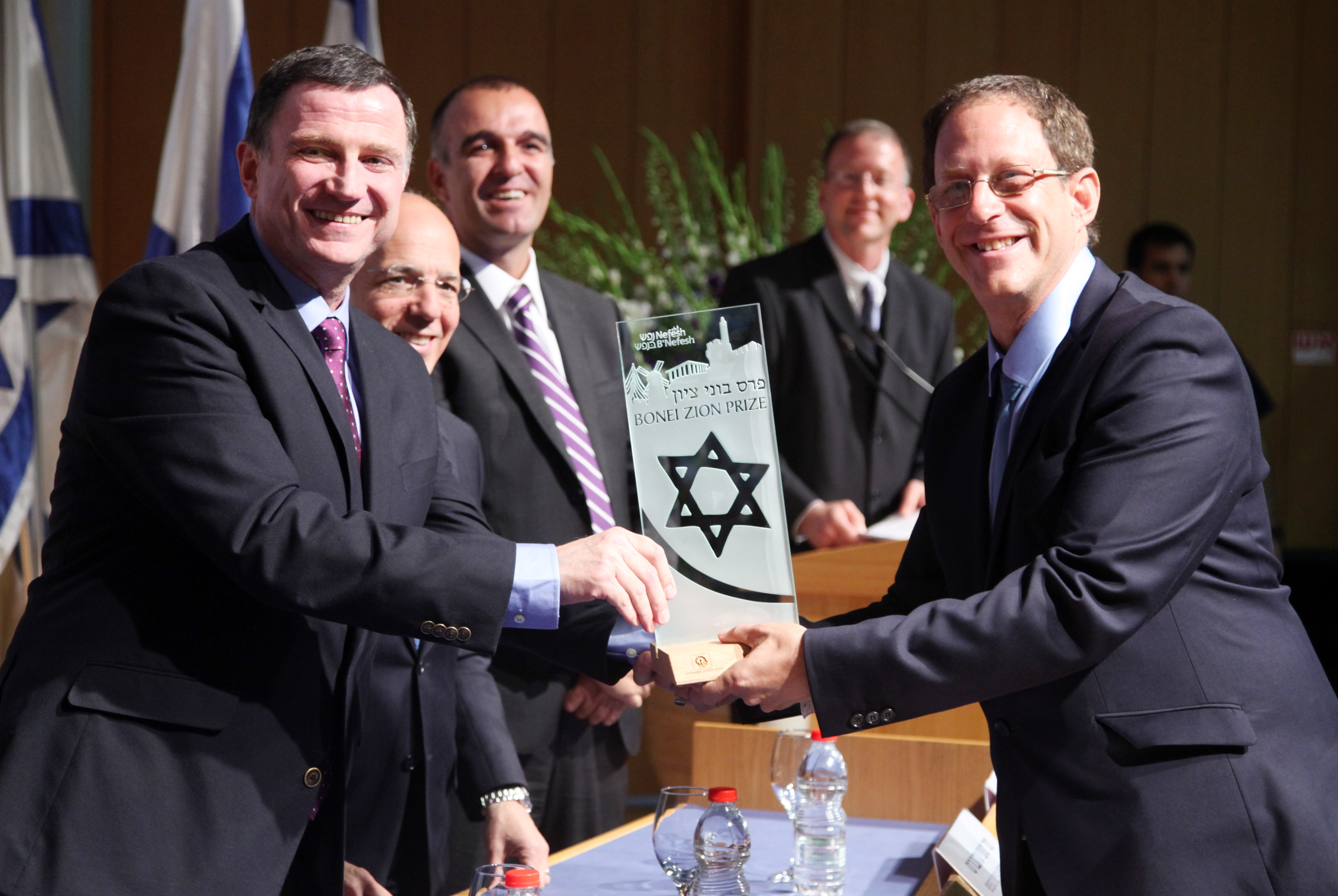
Energiya Global CEO Yosef Abramowitz Takes Home Bonei Tzion Prize for Significant Contribution to the State of Israel

Jerusalem, Israel, May 15, 2014 — In a ceremony at the Knesset, attended by Israeli dignitaries as well as friends and family of this year’s seven prize winners, Yosef Abramowitz, 50, accepted the Bonei Tzion prize in the category of Entrepreneurship and Technology. The prize, now in its third year, recognizes significant contribution to Israeli society by immigrants from English speaking countries. Hundreds of olim, originating from the USA, Canada, South Africa, the UK, Australia and New Zealand were nominated for the prize.


In his address to the prize recipients and attendees, Speaker of the Knesset MK Yuli Edelstein said, The Knesset is proud to host the award ceremony for this noteworthy prize, which I hope will become a traditional reward for Olim who excel in their contribution to the State of Israel and its society.”


Mr. Abramowitz, CEO of Energiya Global Capital and Co-Founder of the Arava Power Company is recognized as a pioneer in the field of solar energy in Israel. Energiya Global was established in order to address the lack of renewable energy in developing nations by exporting Israel’s expertise in this field.


Howie Rodenstein, chairman of Energiya’s advisory board said, “On behalf of the advisory board of Energiya Global Capital I am proud to congratulate Yosef as a recipient of the prestigious Bonei Tzion award. His vision, integrity and boundless enthusiasm will undoubtedly catapult the world's neediest populations toward a higher quality of life by increasing access to renewable and affordable energy in the developing world.”

This year’s other prize recipients are:

  • Community and Non-Profit: Joseph Gitler (USA, 2000), Founder and Chairman of Leket Israel
  • Education: Rabbanit Malke Bina (USA, 1971), Founder and Chancellor of "Matan"
  • Science and Medicine: Professor Jeffrey Hausdorff (USA, 2000), Professor at Tel Aviv University and Director of the Neurodynamics and Gait Research Laboratory  at the Tel Aviv Sourasky Medical Center
  • Culture, Sports and Arts: Yaakov Kirschen (USA, 1972), Creator of “Dry Bones”IDF and National Service Young Leadership: Lt. Nira Lee (USA, 2010), Head of Hasbara at the headquarters of the Coordinator of Government Activities in the Territories (COGAT)
  • Lifetime Achievement: Professor Shimon Glick (USA, 1974), Professor and Dean Emeritus of the Faculty of Health Sciences at Ben Gurion University

Energiya Global’s mission is to bring solar energy to under-served populations in developing nations. The company strives for a triple bottom line, delivering good financial returns to investors in addition to strong socio-economic and environmental returns in developing countries.

yosefboneitzion

For more information, please contact us.

Posted in Press Release | Leave a comment

Yosef Abramowitz Receives Bonei Tzion Award

Last week Yosef accepted the Bonei Tzion award, sponsored by Nefesh B'Nefesh, for extraordinary contribution in the field of technology by an immigrant. The awards ceremony took place at the Knesset and was attended by Speaker of the Knesset Yuli Edelstein.

yosefboneitzion

Posted in Uncategorized | Leave a comment

Business Students Get A Look at Solar Energy

30 students from Darden School of Business at the University of Virginia visited Energiya Global's Jerusalem office today to learn about Israeli innovations at work. group


Posted in Uncategorized | Leave a comment